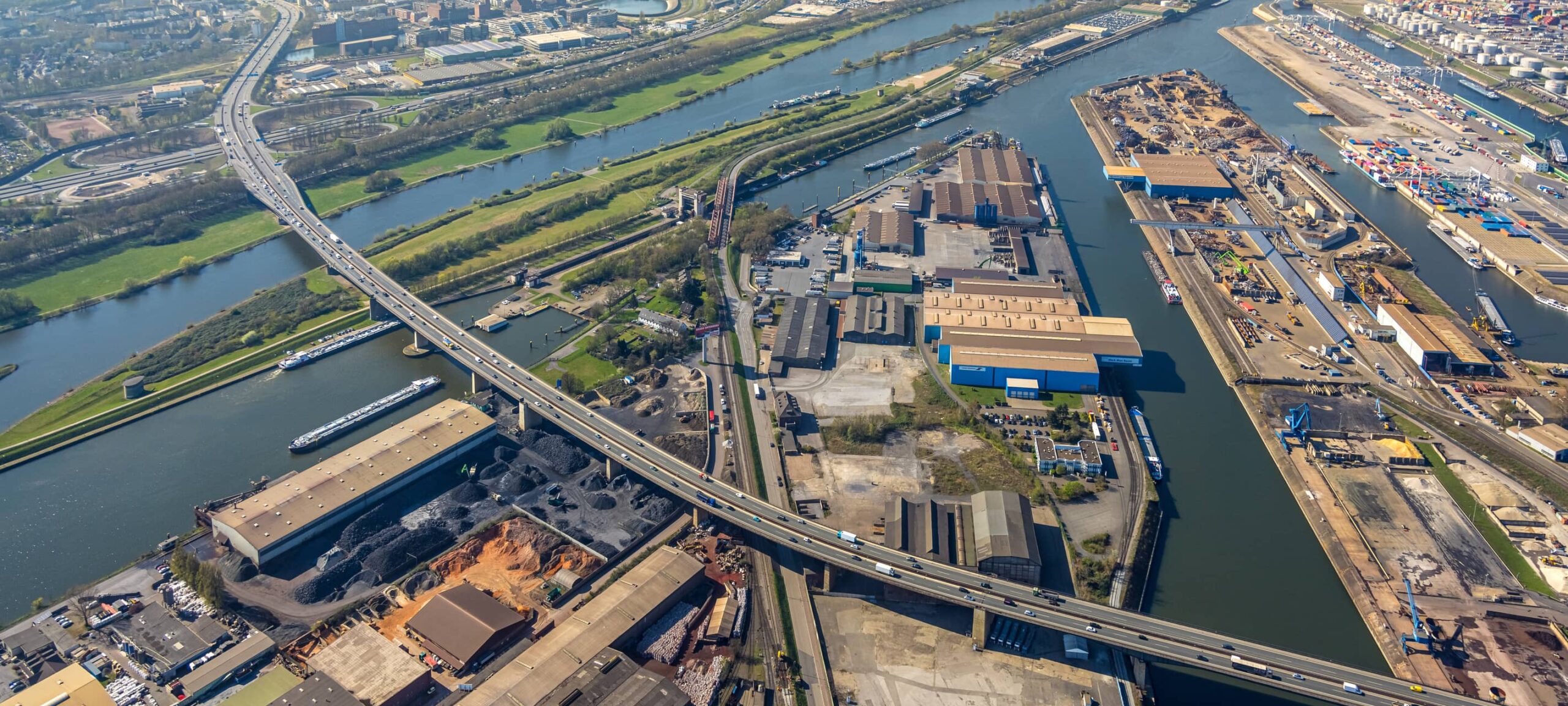
The Berliner Brücke carries the A59 motorway across northern Duisburg — over the Rhine-Herne Canal, over the Ruhr and over the harbour basins, freight yards and industrial areas of right-bank Duisburg. The 1963 structure is 1,824 m long and consists of five separate bridges: the Stadtparkbrücke (328.15 m), Güterbahnhofsbrücke (314.34 m), Hafenbeckenbrücke (274.17 m), Industriebrücke (316.32 m) and Rhein-Herne-Kanalbrücke (219.13 m). The spans over the Ruhr measure 89.91 + 150 + 105.55 m and those over the canal 67.65 + 84.80 + 66.68 m. The new crossing, running between the Duisburg motorway interchange and the Duisburg-Marxloh exit, comprises almost 1,600 m of bridge, 31.10 m wide, as a box girder structure with spans of up to 136 m and six lanes in total, three on each structure. Construction began in January 2026; the first structure is to be completed in 2029, followed by demolition of the old bridge and construction of the second.
Our scope covers some 12,000 tonnes of steelwork in shop detailing for three sections of the structure, and for one of them also the erection documentation and erection engineering. Owing to its scale, the structure has been divided into sections awarded to different contractors.
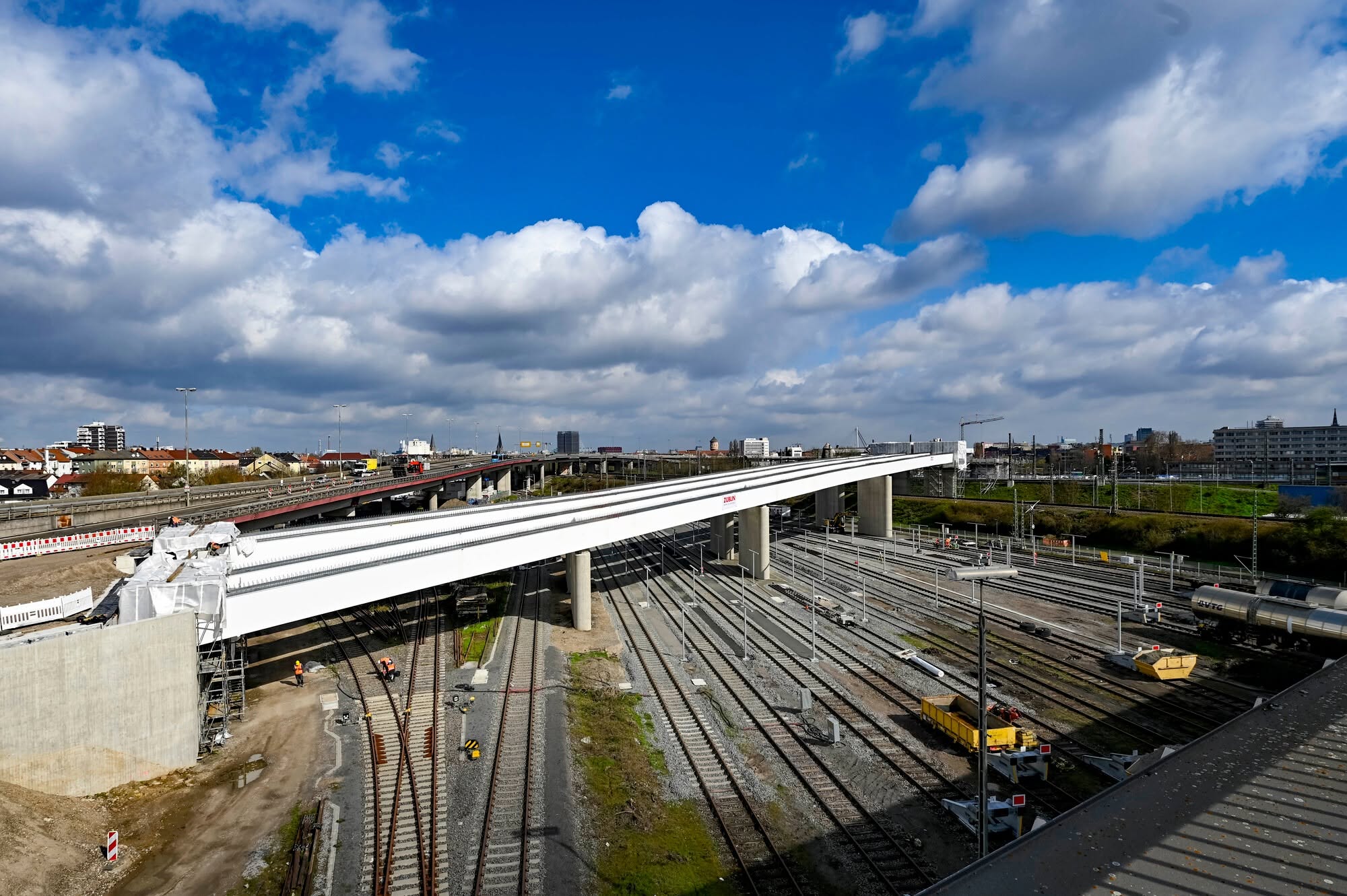
Erection engineering is a separate task here: analysing the behaviour of the structure in intermediate states, before it reaches its final static system. With members of this size, those states determine the position of temporary supports, the splicing sequence and the feasibility of erection above a working canal and live railway tracks.